Sara Darle Olsson

she/her

Sweden, 1999


                             instagram: @sardarols

                             website: saradarleolsson.com
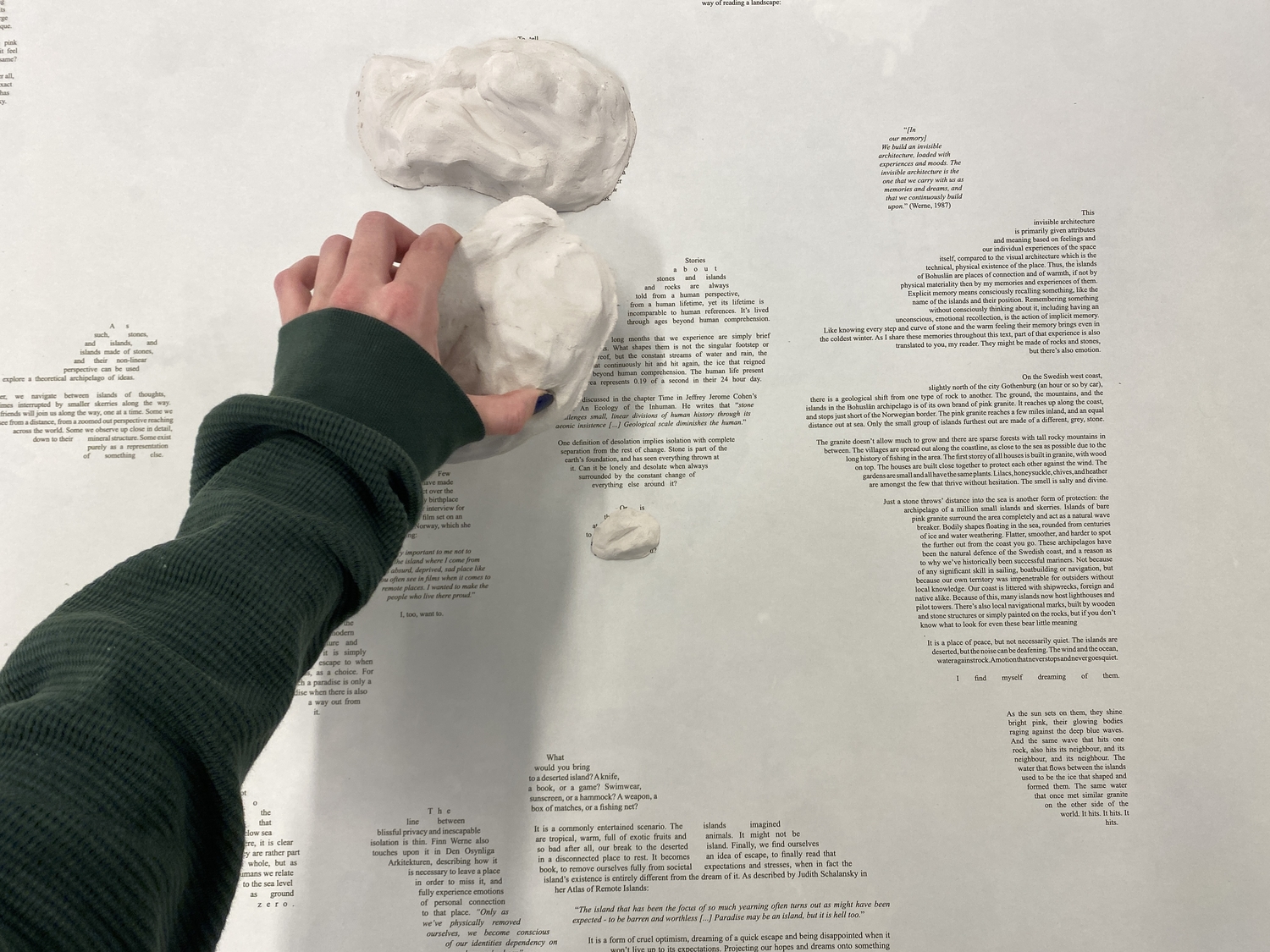
 

Graduation project: The Sincerest Form

For some time, I’ve been questioning the nature that I’ve previously perceived as real, and now believe to be fake. An elaborate theatre play constantly performed without pause, orchestrated by industries larger than life.
 
But sometimes, it feels real. Sometimes I encounter something wild. Water leaking in, weeds growing through cracks, leaves and seeds spreading from bushes and trees. Threatening to enter my home the way I unashamedly enter theirs, with pieces of trash obliviously left behind, carved names and symbols, objects moved out of place or arranged into a neat row.
 
Perhaps they are not part of the set, but the main characters. A dropped ceiling travels from room to room and becomes a stage. Material actors take on the roles of natural elements placed into an unatural order. A choir sings their story in improvised harmony. 
 
And so, in my own staging of the play, I’m proud to present the following cast:
 
ZINK in the role of ZIP TIE
STEEL in the role of AUTUMN LEAF
CARDBOARD in the role of TREE
GLASS in the role of WATER PUDDLE
 

Thesis: That's just how the mountain crumbles

"Crumbles" is a journey across altitudes and landscapes touching upon our human nature, expectations and desires. It carries our contradictions that are difficult to place and to swallow, articulating them in precise theoretical reasoning, like analysing the principle of lesser evil from the lens of suspension of disbelief.

Sara developed a theatrically scripted dialogue around actual field visits, to enter specific scenic views and question them. The urgency of ecological disaster and our exploitative interference with nature contextualises our desires as a coping mechanism with a certain sense of loss. And a reminder of our ancient relationship with a natural environment that both embraces us and lures us to own it.

"Crumbles" proposes that our predative nature might be intertwined with our fulfilment of desire for beauty. But if the sublime is all about the moment and the context, when every landscape is extracted or displaced, what actually remains?


Thesis design by Loren Xu


See also:  Eight Cubic Meters by Sara Darle Olsson and Max Purdon: Les Garbagé